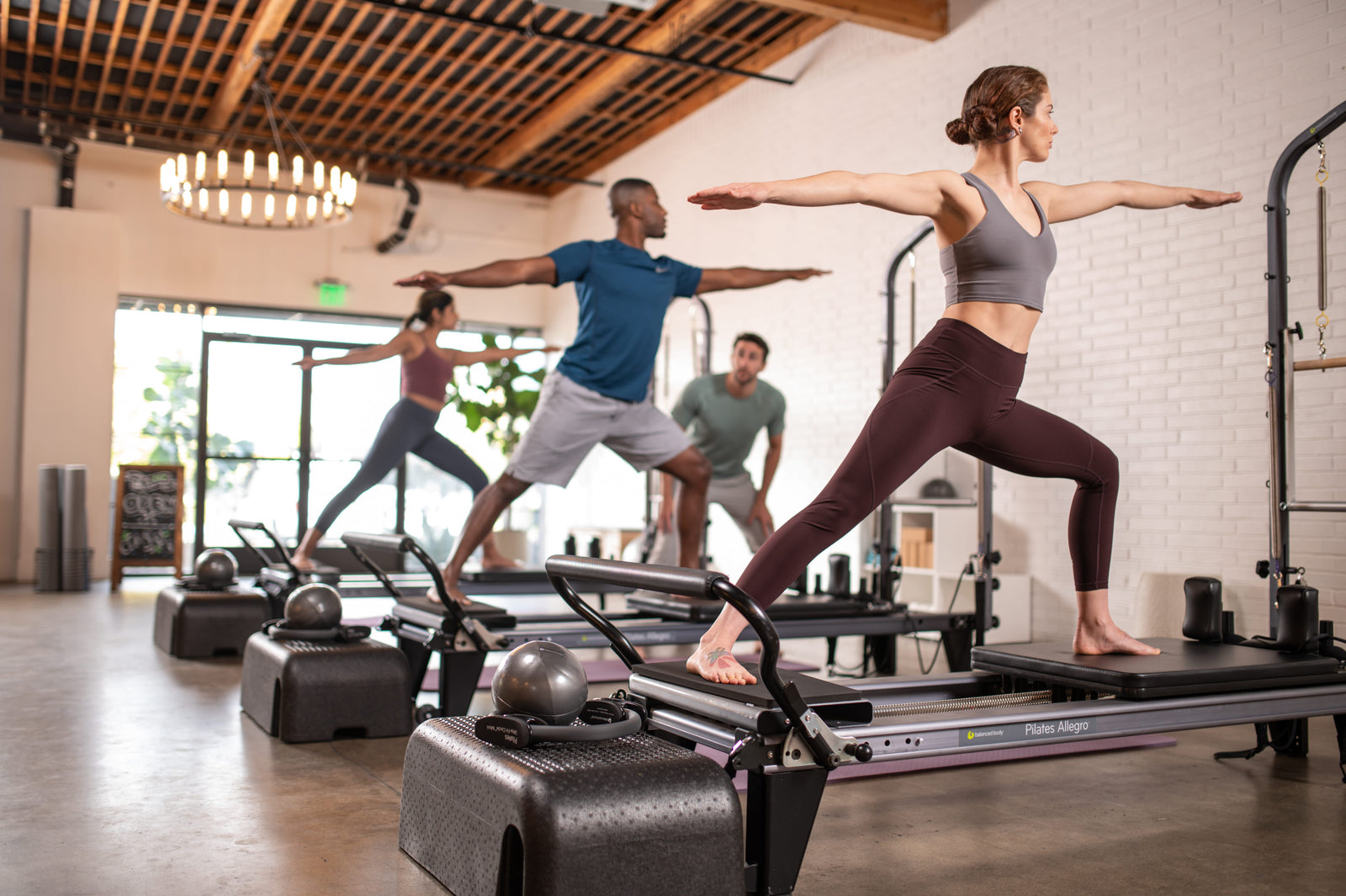


Pilates is currently experiencing strong growth in the health market and is increasingly finding its way out of studios and fitness centers and into physiotherapy treatment settings. The combination of precise movement control, functional strengthening, and conscious breathing opens up new possibilities for patients and therapists in rehabilitation and prevention. We spoke with Lucio Carlucci from the MEDITOPCENTER physiotherapy practice in Seengen about his experiences and why Pilates has increasingly become a strategic part of treatment in his practice.
I have often seen patients make progress in therapy but fail to anchor this progress sufficiently in their everyday lives. Pilates offers a structured system that trains movement awareness, stability, and coordination simultaneously. It is precisely this transfer from therapy to everyday life or sporting activities that convinced me: Pilates complements physiotherapy and makes it effective in the long term.
In cases of chronic complaints, after surgery, or in cases of complex functional limitations, isolated strength exercises are often not enough. Physiotherapists have known this for a long time and therefore integrate proprioceptive and functional elements into their treatment. Pilates adds another valuable element: body tension and core stabilization in every exercise. It requires significantly increased neuromuscular coordination and strengthens the accessory muscles even with very simple exercises and low dosage. The patient is enabled to consciously control movement in an unfamiliar setting instead of just performing instead of . This qualitative improvement can make the decisive difference that leads to successful treatment.
We see clear effects in:
Patients develop a much more pronounced body awareness and discover the joy of this form of movement therapy. At the same time, they begin to actively take responsibility for health. Protective tension decreases and self-confidence in their own movements increases. Posture improves thanks to a strengthened core. These are clear signs for successful for .
Many people are surprised at how intense Pilates Reformer exercises are, even at the lowest dosage. Something we often hear is: "It's not too strenuous, but my muscles are shaking." The Pilates Reformer gives you a strong sense of self-efficacy. You can feel progress quickly—I know this from my own experience.
Pilates Reformer exercises are a very enjoyable way to exercise. Classic stabilization exercises are usually performed lying down, but also often sitting, kneeling, or on all fours. The different spring settings allow the stabilization or coordination training to be adjusted very precisely and individually. This degree of fine-tuning is not possible with standing stabilization exercises, for example. In addition, breathing is added as a motor control element. These elements, as well as the control of the entire functional muscle chains in a precise movement pattern, make the movement not only stronger but also better organized.
Absolutely yes. Pilates gives them the feeling that "I can influence this myself." This increases compliance, and health is created when people remain active. I often find that patients continue to use the Reformer beyond their therapy.
for sustainable for , you need at least one therapist who is enthusiastic about the system. We call this person the "super user." Interestingly, the spark of enthusiasm for the Pilates Reformer is much easier to transfer to other physical therapists than with many other therapeutic devices. The training is fun, and its effectiveness is immediately noticeable.
Otherwise, the same principles apply as for other methods:
This creates economically viable and medically effective added value. We also use this system in personal training, for example.
Yes, Pilates can be a crucial component in the care chain—especially for seamless transition from physical therapy → training → prevention.
for , Pilates is not a fad, but a quality and unique selling point of modern physical therapy.
And most importantly—I'm happy to repeat myself—it's just really fun, both for us physical therapists and for our patients.
Pilates is currently experiencing strong growth in the health market and is increasingly finding its way out of studios and fitness centers and into physiotherapy treatment settings. The combination of precise movement control, functional strengthening, and conscious breathing opens up new possibilities for patients and therapists in rehabilitation and prevention. We spoke with Lucio Carlucci from the MEDITOPCENTER physiotherapy practice in Seengen about his experiences and why Pilates has increasingly become a strategic part of treatment in his practice.
I have often seen patients make progress in therapy but fail to anchor this progress sufficiently in their everyday lives. Pilates offers a structured system that trains movement awareness, stability, and coordination simultaneously. It is precisely this transfer from therapy to everyday life or sporting activities that convinced me: Pilates complements physiotherapy and makes it effective in the long term.
In cases of chronic complaints, after surgery, or in cases of complex functional limitations, isolated strength exercises are often not enough. Physiotherapists have known this for a long time and therefore integrate proprioceptive and functional elements into their treatment. Pilates adds another valuable element: body tension and core stabilization in every exercise. It requires significantly increased neuromuscular coordination and strengthens the accessory muscles even with very simple exercises and low dosage. The patient is enabled to consciously control movement in an unfamiliar setting instead of just performing instead of . This qualitative improvement can make the decisive difference that leads to successful treatment.
We see clear effects in:
Patients develop a much more pronounced body awareness and discover the joy of this form of movement therapy. At the same time, they begin to actively take responsibility for health. Protective tension decreases and self-confidence in their own movements increases. Posture improves thanks to a strengthened core. These are clear signs for successful for .
Many people are surprised at how intense Pilates Reformer exercises are, even at the lowest dosage. Something we often hear is: "It's not too strenuous, but my muscles are shaking." The Pilates Reformer gives you a strong sense of self-efficacy. You can feel progress quickly—I know this from my own experience.
Pilates Reformer exercises are a very enjoyable way to exercise. Classic stabilization exercises are usually performed lying down, but also often sitting, kneeling, or on all fours. The different spring settings allow the stabilization or coordination training to be adjusted very precisely and individually. This degree of fine-tuning is not possible with standing stabilization exercises, for example. In addition, breathing is added as a motor control element. These elements, as well as the control of the entire functional muscle chains in a precise movement pattern, make the movement not only stronger but also better organized.
Absolutely yes. Pilates gives them the feeling that "I can influence this myself." This increases compliance, and health is created when people remain active. I often find that patients continue to use the Reformer beyond their therapy.
for sustainable for , you need at least one therapist who is enthusiastic about the system. We call this person the "super user." Interestingly, the spark of enthusiasm for the Pilates Reformer is much easier to transfer to other physical therapists than with many other therapeutic devices. The training is fun, and its effectiveness is immediately noticeable.
Otherwise, the same principles apply as for other methods:
This creates economically viable and medically effective added value. We also use this system in personal training, for example.
Yes, Pilates can be a crucial component in the care chain—especially for seamless transition from physical therapy → training → prevention.
for , Pilates is not a fad, but a quality and unique selling point of modern physical therapy.
And most importantly—I'm happy to repeat myself—it's just really fun, both for us physical therapists and for our patients.

" for , Pilates is not a fad, but a quality and unique feature of modern physiotherapy."
" for , Pilates is not a fad, but a quality and unique feature of modern physiotherapy."